18
Oct

The no-commission, sealed-bid B2B demand → offer marketplace for natural stone — connecting Aegean stone to the world.
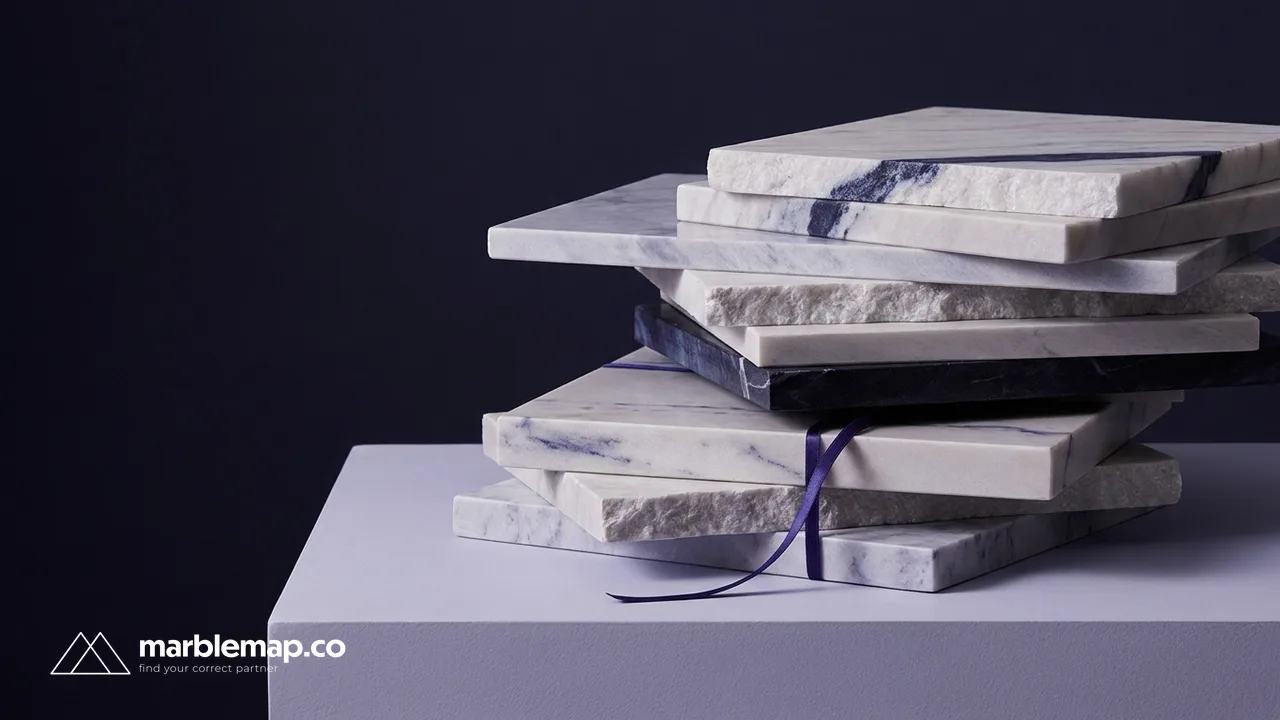
"Which marble is the cheapest?" Everyone shopping for natural stone asks it eventually, and the honest answer is uncomfortable: there is no stable answer, because cheapness is a property of the job, not the stone. A stone that is economical on a 300 m² project can become the expensive option on a 40 m² job with a different finish or a more distant delivery point.
That is why marble carries no price tag: the price is written by the job's specification, not by the stone, and the same stone is priced differently from project to project. This article walks through those seven factors, then flips the question and shows how to write a request that brings back real, comparable quotes.
A buyer searching for "marble price per square metre" hopes to find a single figure, yet every figure they find is a price written for someone else's job. The better approach starts from the job: describe the look you want, the finish, the total area and the delivery location, and let quarries and processors propose the most cost-effective material. The stone choice stays with you, but the price now comes from competing real offers instead of theory.
When a supplier builds a quote, these are the seven inputs. For every one your specification leaves blank, the quote leans that much more on guesswork.
Even marble sold under one name does not carry one price. Stone is graded by veining and colour consistency; two selections from the same quarry can differ significantly in price. "Which grade" is as much a part of the price as "which stone".
Square metres, tonnes or pieces — volume changes the supplier's entire calculation. Block yield, production planning and logistics all work differently at scale — one reason a stone that is economical at 300 m² can become expensive at 40 m².
Cutting, surface finishing and thickness are direct cost lines. A different finish or thickness means different machine time and different waste, so a quote against a request with no processing details is really a price for a different product.
Export stone has to survive the sea and the road. Export-grade crating and pallets feed into the total cost, and a comparison that ignores packaging is incomplete.
The same number carries a very different total cost depending on the Incoterm. Under EXW you collect from the supplier's yard; under FOB the supplier loads the vessel; under CIF freight and insurance to the ship sit with the seller; under DDP the goods arrive at your door, duties paid. Without knowing where responsibility changes hands, two offers cannot be compared.
The gap between an ex-works price and a delivered price grows with distance and route. Change the delivery point and even the most economical stone can swap places in your ranking.
The HS code is a product's customs classification number; origin is where the stone was extracted — Carrara, Italy. Give the supplier both and customs and freight are calculated against the correct tariff line instead of guessed, making quotes more realistic and easier to compare.
MarbleMap has no price list and no product catalogue, because it does not sell stone. The seller is always the supplier — a quarry, a processing plant or an exporter. The platform holds no stock, sets no prices and takes no cut of any sale. A number on a catalogue site is a figure written for yesterday's conditions and someone else's job. On a demand marketplace, the real price arrives as a sealed quote written for your request: verified suppliers bid without seeing each other's prices, every offer lands side by side on one screen converted into a shared comparison currency, and on the Pro plan an AI recommendation also highlights the strongest offer.
"Is it in stock?" is also answered by a quote, not a list. A supplier with the material on hand commits to a short lead time; one that has to produce writes a longer one. In a hurry, sort offers by lead time and pick the fastest — availability becomes a lead-time commitment inside the quote. Currency works with the same clarity: a supplier can price in their own currency, even line by line, while you see everything converted into your comparison currency. The conversion on screen is indicative; the rate is locked the moment you accept an offer.
When you open a new demand, do not stop at a stone name — describe the job: the stone type or the look you want, quantity and unit, cut-finish-thickness expectations, packaging needs, the delivery country and point, and your preferred currencies. The Accepted Incoterms field is offered on the Pro buyer plan, and the HS code and origin fields belong to the itemised demand type — fill them in if you know them. Your Incoterm selection guides suppliers without binding their offers, and if something is missing, suppliers can ask questions inside the demand itself. The sharper the specification, the more your quotes stop being estimates and start being commitments.
The real price of marble does not live in a list; it lives in offers written for your job. If you are a buyer, opening a demand on MarbleMap is free, you owe nothing until you accept an offer, and the platform charges no commission on the sale. Contract, shipment and invoicing run directly between you and the supplier — payment never passes through the platform. If you are a supplier, sealed bids on real demands from vetted buyers let you show what a price list never could: the true price of that job. Start at marblemap.co